
In today’s world, people usually do not buy anything instantly. People conduct research, compare different products or services, and try to get reliable information before making any decision. Thus, it is necessary for marketers to provide not only sales-related but also educational content nowadays. Educational content helps marketers establish themselves as experts in a field, form good relations with clients, and take them step by step through the buying process.
Educational content helps customers solve problems and make decisions. It does not matter whether it is a blog, video, tutorial, or webinar.
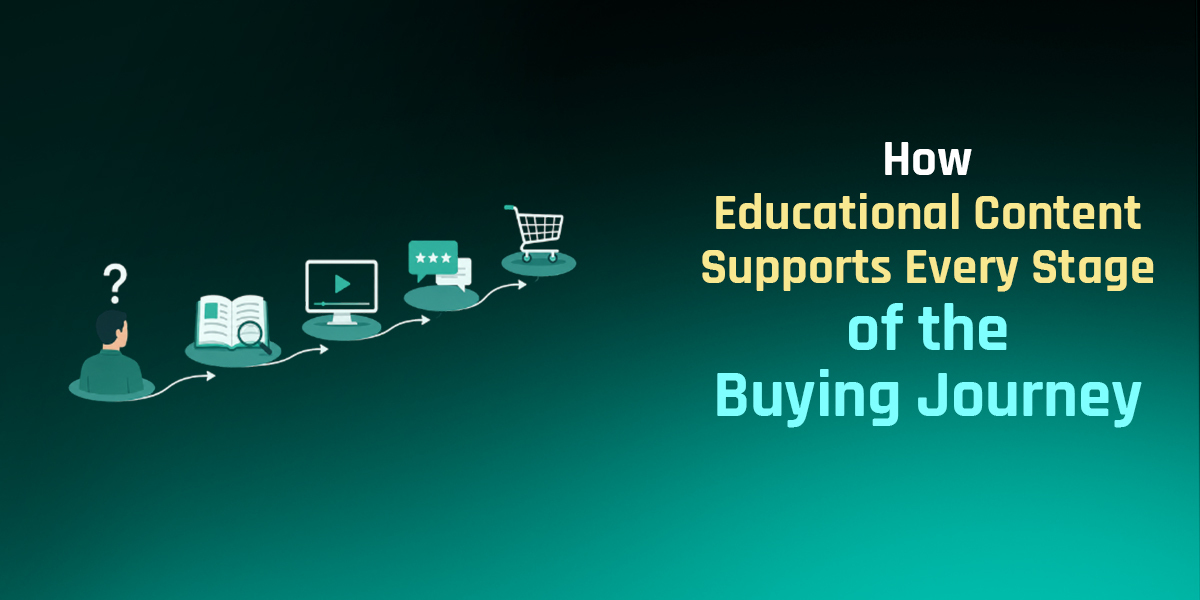
A purchase process is the sequence of actions followed by consumers before purchasing something. The process usually involves several important steps that include awareness, consideration, and decision. Consumers have their own questions and need different information during each step of this process.
During the awareness step, consumers look for a solution to a problem. While at the consideration step, they analyze various options. And at the decision step, consumers select the company they trust the most.
The educational content allows companies to be relevant through the whole journey because it provides useful information to consumers rather than selling anything.
From the start of the buyer’s journey, people need to find useful information, not sales information. Companies that create informative blogs, guides, industry news, and other sources of knowledge may get their audience.
Useful information gives credibility to the company and makes it an authoritative source of information for potential buyers. Companies do not try to make sales; they build relations by being useful.
One of the main reasons why top digital marketing companies pay attention to educational information is to create awareness and earn the trust of their potential buyers.
Customers will be able to make an assessment of all the available options after determining what problem they are trying to solve.
In order for customers to have the information about how the particular option works and what it brings as its result, the following types of content will be useful: comparison articles, case studies, FAQs, product demos, guides.
Transparent and informative content allows answering all the questions that potential customers may have before contacting the business at all.
An educational approach is usually better than a promotional one in terms of building customer relationships.
In the last stage of the purchase cycle, there is a need for assurance. Confidence in their decision is what the customer seeks.
Educational tools like testimonials, implementation guides, onboarding information, and case studies give the assurance that most customers need in making their decision.
An experienced digital marketer in India knows that trust needs to be earned from several engagements and not a single advertisement.
By educating the customers at the decision-making stage, businesses make the decision process simpler.
Educational content extends beyond blogs and articles. It also supports videos, email campaigns, social media posts, downloadable resources, and website experiences.
For businesses investing in website development marketing, educational content improves user engagement by helping visitors quickly find relevant information.
Well-structured websites that answer customer questions encourage longer visits and stronger interaction with the brand.
When educational resources are integrated across multiple digital channels, businesses create a consistent experience that supports customers regardless of where they engage with the brand.
Educational content keeps on giving well after its publication. While marketing promotions only last for the short term, educational content provides ongoing value by bringing in new customers, answering common questions, and aiding customer decision-making for months and even years to come.
Companies that choose to keep educating their customers build their brands' authority, gain customer trust, and achieve better engagement online. However, educational content does something else too—it builds a connection that goes beyond a one-time sale.
With consumer demands changing, companies that prioritize help over sales are going to be successful in the long run.
The purchasing process is no longer about just going from awareness to purchase. Today, customers want brands to guide them, give them answers to their questions, and help them make wise decisions throughout the entire process.
Through the use of educational content, companies get to fulfill the needs of their customers and, at the same time, increase their credibility and relationships with them. Rather than considering content marketing as a way to advertise, companies should view it as a means for adding value and making decisions based on knowledge.


© 2023 Copyright damnZgood. All Rights Reserved.




.png)
